Exhibition
1–26 February, Akademie der Künste


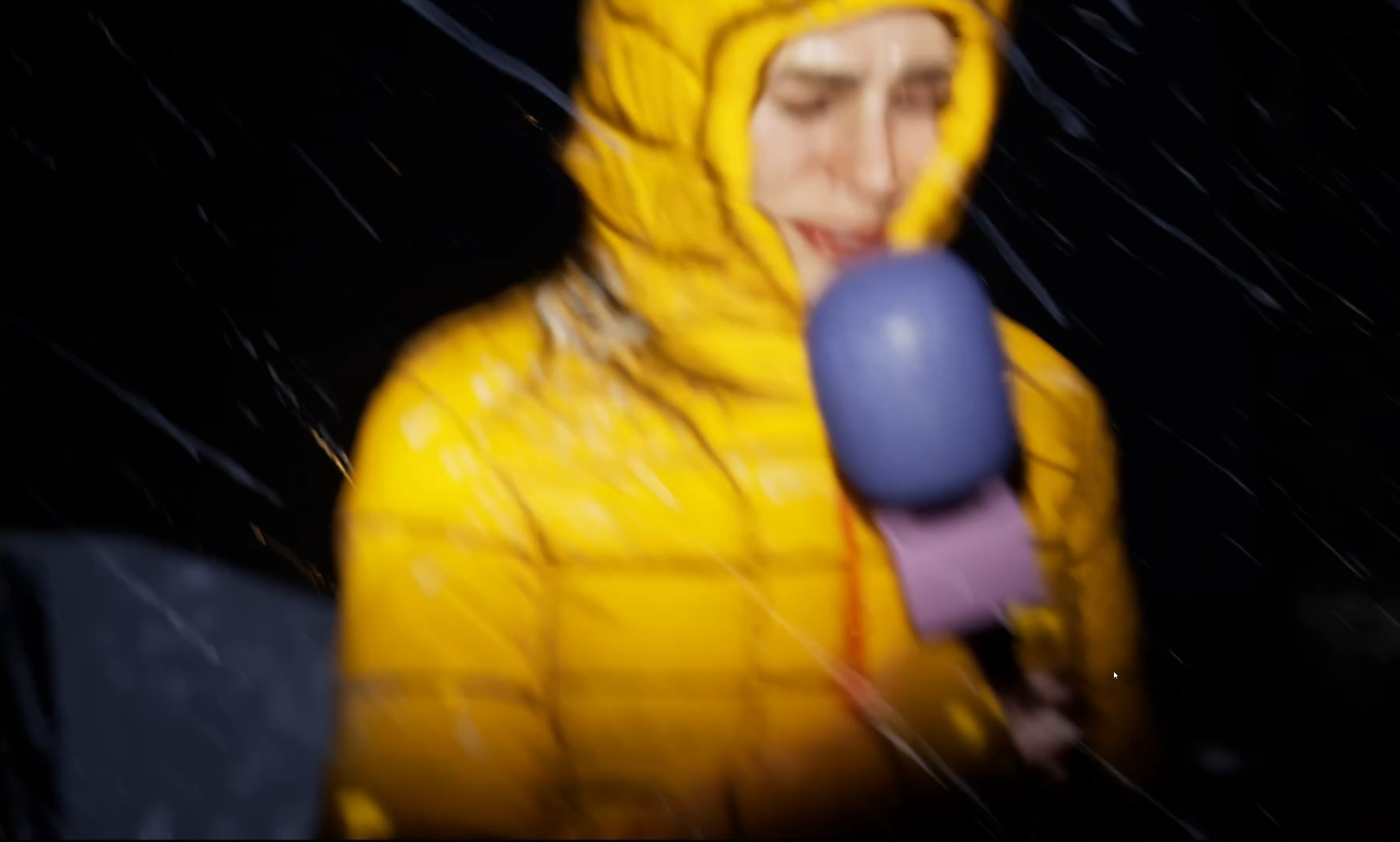
Or So It Seems is collaborative exchange between Alan Butler and Simone C Niquille that interrogates the technical and socio-political implications of computer-vision technologies. A simulation of an extreme weather report of a never-ending storm is interrupted by duckrabbit – the star of an animated TV series – who tells their queer coming-of-age story of self-discovery and their struggles with vision technologies. Roaming through California’s Yosemite National Park, the news reporter screams My First Summer in the Sierra (1911), an account of ‘nature writing’ by John Muir, in defiance of the storm, while duckrabbit ponders their desires for ambiguity in a world composited and remade with CGI assets.
As these worlds begin to collide and blur, their uncanny representations come apart at the seams. Questioning the gaps between the realities generated by CGI and simulation technologies and their high-resolution capturing of the present, Or So It Seems asks how we hold together when the line between impending doom and entertainment becomes unclear.
The exhibition features the premiere of two new video works by Alan Butler and Simone C Niquille.
This FAQ was written by Lorena Juan and Nora O Murchú, who collaborated with Alan Butler and Simone C Niquille to make this exhibition.
What is happening?
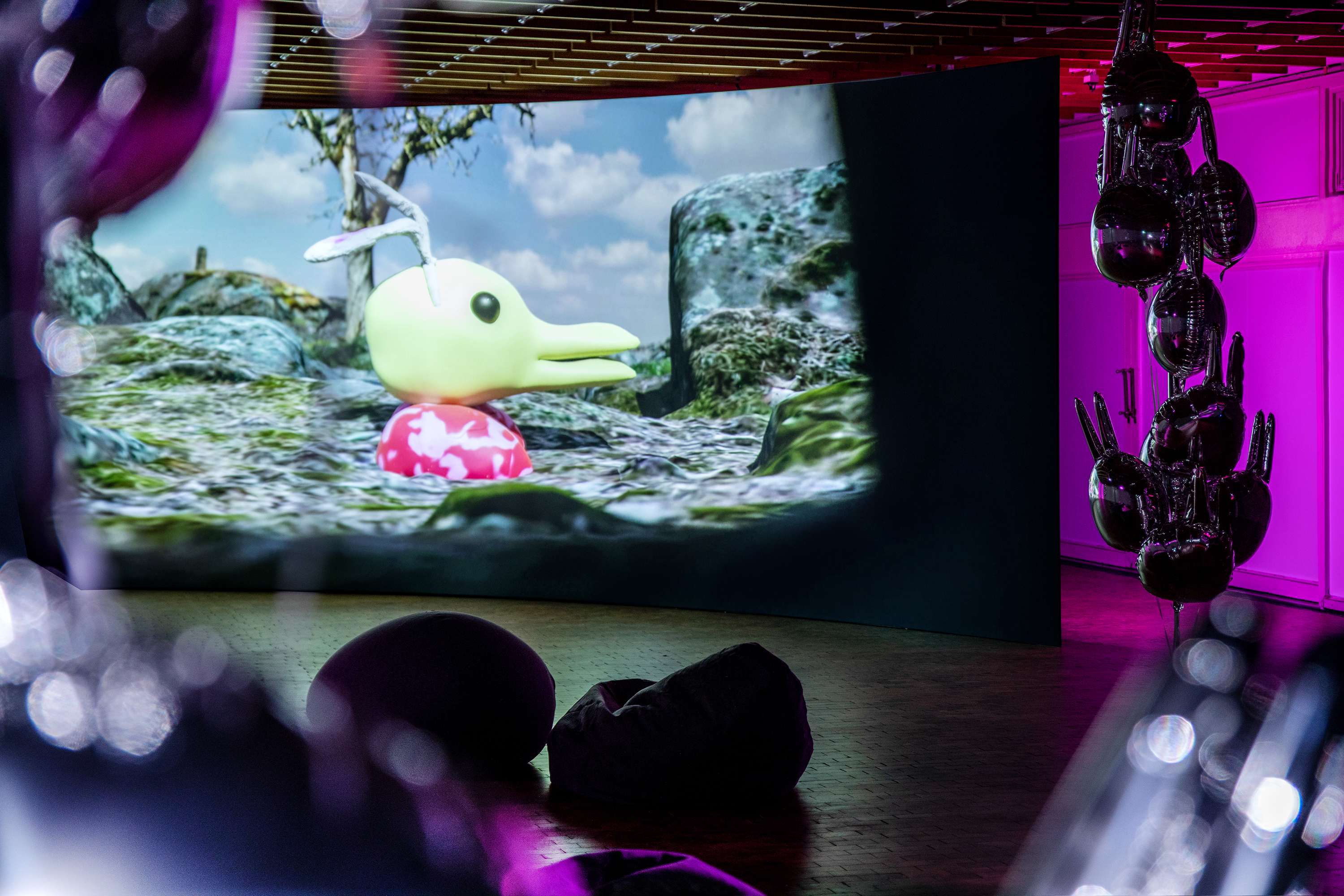
In the middle of a gallery space, on a giant 10m curved screen, we see two very different computer-generated worlds: a real-time simulation of an extreme weather report and a series of clips from the forthcoming animated TV series duckrabbit.tv. Around the space are silver foil duckrabbit balloons that are blown around by fans that turn on and off in sync with the extreme weather report on the screen. The computer that generates the simulation in real time also produces the audio of the wind that you can hear, and in a way attempts to situate you inside the simulated storm itself.
What is the exhibition about?
The exhibition draws attention to the socio-political impact of computer-generated images and simulation technologies that are deployed widely in different contexts such as entertainment, domestic environments, architecture, and shopping. The images generated by these technologies are different kinds of images – they distinguish themselves from pictures that are taken to record and interpret the world. These images are made from data, they can be synthesised from datasets, measure environments, and transform realities with their representations of our surroundings or ourselves. Consequently, they come with a set of politics attached – often someone else’s – and as we use devices and networks they act as scalable portraits of the world, amplifying those politics.
How does this relate to transmediale’s festival theme?
The 2023 festival edition explores how scale reconfigures relations, politics, and affects in an age of mass images. In this exhibition, Alan Butler and Simone C Niquille are not thinking about scale as a reference to things as big or small, but instead approach scale as something that is constantly made and remade by the images we see and the devices we use.
What is the weather forecast reporter saying?
The news report takes place on a virtual terrain with a topology modelled on that of Yosemite. The simulation unfolds across 200 km² of the 3,027 km² that the national park covers. As they roam this landscape, the news reporter screams-reads My First Summer in the Sierra (1911), an account of nature written by John Muir. Muir was a preservationist who saw the natural world as sacred and divine that should be saved from the corrupt hands of human society. In his campaign to make Yosemite a national park, the spiritual quality of his writing and his enthusiasm for nature inspired many readers, including then President Roosevelt, and led to the establishment and preservation of the park. Walking through this now-altered landscape, the weather reporter screams an image for the audience to consume: an image of the world that once was, pointing to the long legacy and role of image-making technologies in mythologising the Western notion of Nature.
Who is duckrabbit?
Duckrabbit is the protagonist of a forthcom-ing animated TV show – duckrabbit.tv. The animated series is a coming-of-age story about their self-discovery, queer life, and struggles with technology (or society) that wants them to be one thing, when they are another, or perpetually in flux. Duckrabbit is modelled after an illustration by Joseph Jastrow from 1892, brought to fame by its use in Ludwig Wittgenstein‘s Philosophical Investigations (1953). On the screen, duckrabbit navigates through a series of short scenarios that sees them explore their 3D composited world. Confronted with multiple replications of reality and their representations of truths, duckrabbit doesn’t bother to try to comply. Instead, they desire to stay ambiguous, slipping under the radar in a world of CGI production and its many problems.
Who are Simone C Niquille and Alan Butler?
Simone C Niquille is a designer and researcher based in Amsterdam who investigates the representation of identity and the digitisation of biomass in networked spaces of appearance. Alan Butler is an Irish artist whose work explores material and philosophical ideas about how imagery and meaning function in technologically-mediated realities.